About Waterjet Cutting

History

Initially, the waterjet was first conceived to remove, or erode, large amounts of earth, soil, and sand from mountain sides or valleys during the mining era in the early 1900’s. Water was plumbed from a nearby stream and directed on areas to blast through surfaces and move the slurry mixture for post processing. By the 1960’s, the focus of the technology had moved to the aircraft manufacturing sector, which was looking for alternative ways to cut carbon fiber and other composites. The first breakthrough came from Dr. Norman Franz, a forestry engineer, who initially was researching a new method for cutting wood in the timber industry. He would drop large stones in water columns to force the water through small orifices. This created mostly inconsistent water pressures of 30,000 PSI and sometimes higher. Although Dr. Franz’s research didn’t prove to be an effective wood cutter, it did, however, help him patent the first waterjet cutting machine in 1968. Waterjet cutting in the 1970’s was limited to paper, cloth and other soft, thinner materials. In the early 1980’s, the second breakthrough occurred when Dr. Mohamed Hashish and Flow International, Inc. created the abrasive waterjet cutting technology we know today. By adding abrasive to the water stream, the waterjet was able to cut materials like, stone, metal, glass and other dense materials. Flow International, Inc sold the first waterjet cutting machine to an automotive glass manufacturer and then others soon followed. Intensifiers were built to create consistent water pressure up to 60,000 PSI and components were designed and built to precisely meter the amount of abrasive consumed. This, in turn, made the waterjet technology both reliable and affordable to the manufacturing industry. The AWJ cutting machine was capable of cutting almost any material and thickness. The popularity of waterjet cutting grew rapidly as the technology continued to advance and component life turned from minutes and hours to days and weeks.

Today, diamond orifices are replacing sapphire orifices and standard carbide nozzles are being replaced by composite carbides. These components offer longer life than their predecessors and help provide the repeatable results manufacturing requires. This allows for longer runs with virtually no downtime to replace consumables or worn components. Diamond orifice cutting heads offer a significant advantage in the life and quality of the stream of the waterjet. The quality of stream of a waterjet reflects in the quality of the parts being cut. Also, engineering improvements for the consumable components for waterjet systems are continually reducing the overall operating costs by reducing downtime and increasing wear-life.

Definition

Abrasive waterjet cutting (AWJ) is a non-conventional cutting method that uses a stream of ultra-high pressured water with a powdered abrasive to cut all types of materials. These materials include, but are not limited to, titanium, carbon steel, aluminum, stainless steel, copper and plastic. For less dense material such as foam and rubber, only a waterjet stream without the abrasive is required. This is sometimes referred to as “pure waterjet cutting”.

The Process

The theory of operation is simple: Water + Pressure + Abrasive = Accelerated Erosion.

The short version-
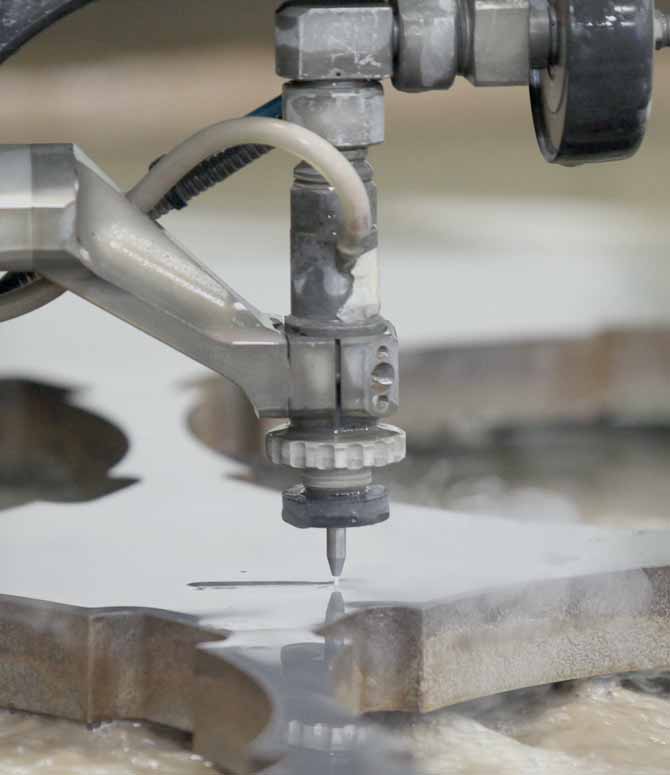
Water is intensified to a pressure of 60,000 psi and plumbed to a cutting table. Abrasive is added to the water stream and passed through a focusing tube. The abrasive-laden water stream is about the size of a pencil lead and carries enough energy to cut through 24” thick steel plate.

Below is a more in-depth view of the waterjet cutting process:

  1. 1) It begins when incoming water is filtered, softened and processed through a reverse osmosis system, and then collected in large, clean storage tanks.
  2. A pre-stage water pump is used to boost the processed water from the storage tank to the intensifier units. Water pressure at this point is 80 psi.
  3. On each intensifier unit, the water passes through a 2-stage filter assembly, a 1-micron and 0.2-micron, high-flow filter. The water at this point is virtually free of any minerals and impurities.
  4. As the intensifier starts its working cycle, water is drawn through a low-pressure check valve into a cylindrical chamber by a long ceramic rod, called a plunger. The plunger draws all the way back in the chamber and then, with the chamber full of water, it starts to reverse direction.
  5. A large industrial electric motor powers the hydraulic system used to move the plunger back and forth.
  6. As the plunger begins the “power stroke”, water is confined to the chamber by the check valve, and begins to move through the high pressure check valve. As the cycle continues, the pressure continues to build until the water pressure setting of 60,000 psi is reached. (An intensifier averages about 80 to 100 cycles per minute)
  7. When at full pressure, the water is plumbed to a cutting table via hardened stainless steel tubing, valves, elbows and in-line filters.
  8. Water travels to each cutting head assembly where the pressurized water sits until a cutting head is actuated.
  9. The cutting head has its own pneumatic on/off valve assembly, featuring fail-safe components containing a needle and seat.
    1. When the cutting head is turned OFF, a spring exerts pressure on a hardened stainless steel needle forcing it against a seat, which in turn stops water from passing.
    2. When the cutting head is turned ON, air pressure overrides the spring pressure and raises the needle so water can pass through the seat and down to the diamond orifice.
  10. The orifice determines the flowrate of the water, and in turn the amount of power in a cutting head. An intensifier is rated in gallons per minute (GPM) and orifices come in a variety sizes, from 0.003” to 0.024”. The added horsepower of the larger size orifices result in faster speeds, but the additional GPM requirement can limit the amount of cutting heads.
  11. For pure waterjet cutting, the stream of water can slice through any thickness of foam, rubber, paper or cloth. The stream of water is crystal clear and resembles a section of monofilament fishing line. The speed of the stream at high pressure is approximately 1,500 to 3,500 miles per hour (depending on the orifice diameter size).
  12. 12) For abrasive waterjet cutting, after the water exits the orifice the abrasive is added to the stream via the mixing chamber. The abrasive flowrate can vary between 0.5 – 2.0 lbs. per minute, depending on orifice and focusing tube combinations.
  13. The water and abrasive mixture continues through the focusing tube, which is a composite carbide material. The focusing tube is the last component in the waterjet cutting system before contacting the material. The diameter of the focusing tube determines kerf width. Typically, the diameter of focusing tubes ranges from 0.020’’ to 0.050”.

Think Green

Waterjet is considered a "green" technology. Waterjet processing, when compared to other cutting technologies, produce no hazardous waste, thus reducing waste disposal costs. They can cut off large pieces of reusable scrap material that might have been lost using traditional cutting methods. Parts can be closely nested to maximize material use and the waterjet saves material by creating very little kerf. Waterjets use very little water (a half gallon to approximately one gallon per minute depending on cutting head orifice size), and the water can be recycled using a closed-looped system. Waste water usually is clean enough to filter and dispose of down a drain. The garnet abrasive is a non-toxic natural substance that can be recycled for repeated use and can ultimately be disposed of in a landfill. Waterjets also do not generate airborne dust particles, smoke, fumes, or contaminates when cutting materials such as asbestos and fiberglass, which greatly improves the work environment.